After several very busy weeks, I was able to collect a few hours yesterday morning for some project-scale cooking. Fifteen lemons were picked, peeled, and juiced:
And prepped like so:
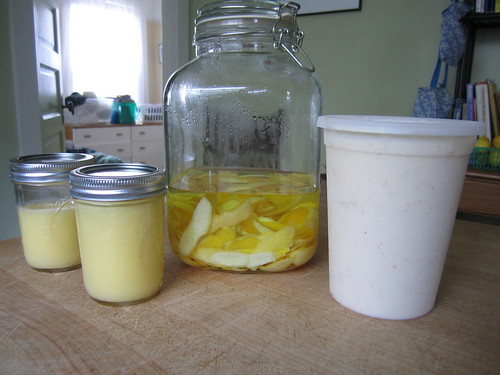
(center) After scraping off any white pith on the peels, put them in this year's batch of limoncello.
Use 1 c lemon juice to make 3 c lemon curd (this time by adding the lemon juice to 1/3 c butter, 1.5 c sugar, and 5 eggs, and whisking over a double boiler until thick).
(right) Use half of the lemon curd in hot toddy ice cream (this time by whisking 1/4 c honey, 1/8 t cloves, 1 T lemon zest, 1.5 c cream, 1/2 c 1% milk, and 1/4 c bourbon into 1.5 c lemon curd, then chilling and churning as usual).
(left) Put the other half of the lemon curd in jars for later. It's almost but not quite overpoweringly sweet and tart, as lemon curd should be, and a good consistency for spreading or dolloping. (The sourdough pancakes were disappointingly rubbery though.)
Give the rest of the lemon juice to Laura so she can make some dressing for an asparagus + feta pasta salad.
Monday, February 27, 2012
Sunday, February 12, 2012
Beer + cheddar + mustard bread
Lester has been excited about this ever since Toni linked to it a few days ago. And what sounds like a better use of a Sunday than either writing a talk or making beer/cheddar/mustard bread? Adapting beer/cheddar/mustard bread for sourdough. The pull-apart style is great, but the rolls are very good too if that's more your speed.
bread:
1 t yeast
1/2 c pale beer (eg TJ's Mission St)
1 c starter
2.5 c bread flour
1/4 c rye flour
1/4 c wheat bran
1/2 stick butter, softened
1 egg
1.5 t salt
fillings:
3 T melted butter
1 T Dijon mustard
1.5 t bbq sauce
hot sauce to taste
1.5 c shredded cheddar
1 t mustard powder
1 t paprika
1/2 t salt
ground pepper
Dissolve the yeast in the beer, then combine all of the bread ingredients and knead until smooth and elastic. Let rise until doubled (about 6-8 hr). When you're about ready to form the bread, make the fillings: the mustard filling (stir together the melted butter, mustard, bbq sauce, and hot sauce until smooth) and the cheese filling (mix together the cheddar, mustard powder, paprika, salt, and pepper until the cheese is evenly coated with spices).
Butter a loaf pan (9x5") and find a muffin tin in case you have extra dough. Flour a surface and turn out the dough. Roll the dough into a rectangle that's at least 20"x12" (mine was closer to 24"x15") and has fairly straight sides and square corners. Spread the mustard filling evenly over the entire surface of the dough, then slice into 4"x12" (or longer, but not wider) strips. Sprinkle 1/(number of dough strips)ths of the cheese on one strip of dough, place another strip on top, sprinkle with more cheese, etc. Slice the stack into 2"-3" wide strips. Tip your loaf pan so it's standing on the short side, and stack the stacks on top of each other until the pan is full (4" side along the 5" side of the loaf pan, 2" side along the usually-vertical side of the pan). When you tip the pan back to its normal position, the slices of dough should be standing up like slices of bread, which is exactly what they are. If you have extra dough, butter that muffin tin and roll extra strips into little muffin-size rolls (I got 6 rolls). Cover with a plastic bag and let rise until the dough is puffy but not yet filling the pans (about 2-3 hr).
When Laura starts making dinner, preheat the oven to 350F. Bake for 30-35 minutes until nicely browned and very much filling the pans. Let cool for just a couple minutes, then remove from the pans. If the slices come out of the pan in chunks because some cheese got crusted onto the pan despite your thorough buttering, just stand those chunks next to each other on the cutting board and enjoy.
bread:
1 t yeast
1/2 c pale beer (eg TJ's Mission St)
1 c starter
2.5 c bread flour
1/4 c rye flour
1/4 c wheat bran
1/2 stick butter, softened
1 egg
1.5 t salt
fillings:
3 T melted butter
1 T Dijon mustard
1.5 t bbq sauce
hot sauce to taste
1.5 c shredded cheddar
1 t mustard powder
1 t paprika
1/2 t salt
ground pepper
Dissolve the yeast in the beer, then combine all of the bread ingredients and knead until smooth and elastic. Let rise until doubled (about 6-8 hr). When you're about ready to form the bread, make the fillings: the mustard filling (stir together the melted butter, mustard, bbq sauce, and hot sauce until smooth) and the cheese filling (mix together the cheddar, mustard powder, paprika, salt, and pepper until the cheese is evenly coated with spices).
Butter a loaf pan (9x5") and find a muffin tin in case you have extra dough. Flour a surface and turn out the dough. Roll the dough into a rectangle that's at least 20"x12" (mine was closer to 24"x15") and has fairly straight sides and square corners. Spread the mustard filling evenly over the entire surface of the dough, then slice into 4"x12" (or longer, but not wider) strips. Sprinkle 1/(number of dough strips)ths of the cheese on one strip of dough, place another strip on top, sprinkle with more cheese, etc. Slice the stack into 2"-3" wide strips. Tip your loaf pan so it's standing on the short side, and stack the stacks on top of each other until the pan is full (4" side along the 5" side of the loaf pan, 2" side along the usually-vertical side of the pan). When you tip the pan back to its normal position, the slices of dough should be standing up like slices of bread, which is exactly what they are. If you have extra dough, butter that muffin tin and roll extra strips into little muffin-size rolls (I got 6 rolls). Cover with a plastic bag and let rise until the dough is puffy but not yet filling the pans (about 2-3 hr).
When Laura starts making dinner, preheat the oven to 350F. Bake for 30-35 minutes until nicely browned and very much filling the pans. Let cool for just a couple minutes, then remove from the pans. If the slices come out of the pan in chunks because some cheese got crusted onto the pan despite your thorough buttering, just stand those chunks next to each other on the cutting board and enjoy.
Friday, February 3, 2012
Basic sourdough bread
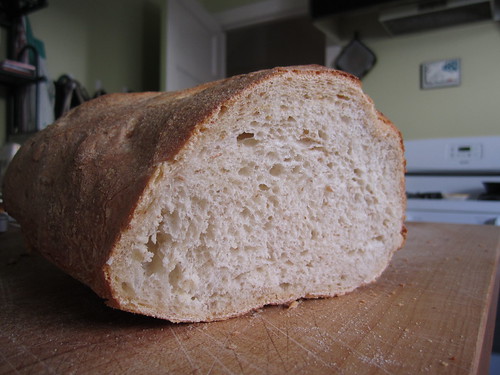
This is the "San Francisco" sourdough from Crust & Crumb. I've made it several times now, with various combinations of rising times, flours, and loaf shapes, and it's turned out extremely well every time. Golden crackly crust that's just the right thickness; soft crumb with lots of elasticity and structure; sourdough flavor that comes through nicely in a plain loaf but doesn't distract from a sweeter bread like cinnamon raisin; enough longevity to be edible three days later if it makes it that long.
The main difference from the La Brea sourdoughs is that the starter gets "elaborated" into what Reinhardt calls a firm starter and I call a proto-dough, which sits for a day or so before you actually make the bread. This step takes some planning ahead, but it's no more than 4 minutes of active time, and I think it helps make the timing of the later steps more flexible (although I haven't tried leaving it out so I can't say for sure).
You'll need to start with some sourdough starter, which I'd be more than happy to provide. The starter can sit in the fridge for several days between feedings (feed 1 c flour + 3/4 c room-temp water to 1 c starter). This makes 2.5 pounds of dough (enough for one huge, two medium, or one large and 1-3 small loaves).
proto-dough:
1 c starter that's been fed in the last day or two
1 c white bread flour
Knead the starter and flour together until it comes together into slightly sticky dough. It'll seem way too dry at first, but you shouldn't actually need to add any extra water. Place the dough in a medium bowl, cover with plastic wrap or a shower cap, and let sit at room temp until about doubled (I've left it for 6-12 hr, ie overnight or for a workday). Use now, or stick in the fridge for up to a day.
bread:
3 c white bread flour (13-14 oz); or 2 c white bread flour + 1 c other grains (whole wheat flour, polenta, etc) + 1 T gluten
1.5 t salt
1 t barley malt syrup (or sugar)
1 c room-temp water
up to 1/4 c wheat bran
up to 1 c extra goodies: oats, walnuts, sunflower seeds, raisins, etc
all of the proto-dough, torn into pieces (12-13 oz)
Combine all of the ingredients and knead until warm and elastic (6-8 min in a stand mixer with a dough hook on medium, or 10-15 min by hand). It's supposed to get up to 77-80F, but mine never has. Place the dough in a large bowl, cover with plastic wrap or a shower cap, and let sit at room temp until at least starting to rise (minimum 4 hr, but I've left it as long as 12 hr and it's more than doubled by then).
Prepare wherever you want the dough to rise: grease loaf pans for sandwich loaves, line baking sheets with parchment and sprinkle with semolina for free-form loaves, or flour a dishtowel and line a proofing basket or baking sheet for boules or baguettes (respectively). Transfer the dough onto a barely floured surface and divide into pieces for whatever loaves you want to make. For round boules, form the dough into a ball. For cylindrical loaves like batards, baguettes, or sandwich loaves, press the dough into a rectangle, roll or fold the sides over, pinch the seam together, and roll gently on the surface to smooth the seam. Place in your prepared proofing place (seam down for sandwich loaves or free-form loaves, seam up if you're putting it on a dishtowel. For baguettes, bunch up the towel in between the loaves, using the towel and the adjacent loaves to help guide the rising up rather than out (this is called a couche). Cover with a plastic bag and let rise until 1.5-2 times the size (ok for 3-8 hr). Bake when risen, or close the bag with a twisty tie and put in the fridge overnight.
If the loaves are in the fridge, take them out at least an hour before you want to put the bread in the oven. If they're on a towel, transfer onto semolina-ed parchment, seam side down. About half an hour before you want to put the bread in the oven, put a pizza stone in the oven if you have one and start preheating to 475F. Just before baking, cut the top of the loaves (these cuts will expand in the oven) and spray water all over the oven with a spray bottle. Slide the loaves with their parchment onto the pizza stone, making sure there's at least a few inches in between loaves, and spray the oven again. After a couple minutes, spray again and turn the heat down to 450F. Bake for 25-30 minutes total, rotating the loaves halfway through if needed. When the loaves are golden all over, turn off the heat and leave the bread in the oven for another 10 minutes to keep browning. Let cool on a rack for at least half an hour before slicing.
The main difference from the La Brea sourdoughs is that the starter gets "elaborated" into what Reinhardt calls a firm starter and I call a proto-dough, which sits for a day or so before you actually make the bread. This step takes some planning ahead, but it's no more than 4 minutes of active time, and I think it helps make the timing of the later steps more flexible (although I haven't tried leaving it out so I can't say for sure).
You'll need to start with some sourdough starter, which I'd be more than happy to provide. The starter can sit in the fridge for several days between feedings (feed 1 c flour + 3/4 c room-temp water to 1 c starter). This makes 2.5 pounds of dough (enough for one huge, two medium, or one large and 1-3 small loaves).
proto-dough:
1 c starter that's been fed in the last day or two
1 c white bread flour
Knead the starter and flour together until it comes together into slightly sticky dough. It'll seem way too dry at first, but you shouldn't actually need to add any extra water. Place the dough in a medium bowl, cover with plastic wrap or a shower cap, and let sit at room temp until about doubled (I've left it for 6-12 hr, ie overnight or for a workday). Use now, or stick in the fridge for up to a day.
bread:
3 c white bread flour (13-14 oz); or 2 c white bread flour + 1 c other grains (whole wheat flour, polenta, etc) + 1 T gluten
1.5 t salt
1 t barley malt syrup (or sugar)
1 c room-temp water
up to 1/4 c wheat bran
up to 1 c extra goodies: oats, walnuts, sunflower seeds, raisins, etc
all of the proto-dough, torn into pieces (12-13 oz)
Combine all of the ingredients and knead until warm and elastic (6-8 min in a stand mixer with a dough hook on medium, or 10-15 min by hand). It's supposed to get up to 77-80F, but mine never has. Place the dough in a large bowl, cover with plastic wrap or a shower cap, and let sit at room temp until at least starting to rise (minimum 4 hr, but I've left it as long as 12 hr and it's more than doubled by then).
Prepare wherever you want the dough to rise: grease loaf pans for sandwich loaves, line baking sheets with parchment and sprinkle with semolina for free-form loaves, or flour a dishtowel and line a proofing basket or baking sheet for boules or baguettes (respectively). Transfer the dough onto a barely floured surface and divide into pieces for whatever loaves you want to make. For round boules, form the dough into a ball. For cylindrical loaves like batards, baguettes, or sandwich loaves, press the dough into a rectangle, roll or fold the sides over, pinch the seam together, and roll gently on the surface to smooth the seam. Place in your prepared proofing place (seam down for sandwich loaves or free-form loaves, seam up if you're putting it on a dishtowel. For baguettes, bunch up the towel in between the loaves, using the towel and the adjacent loaves to help guide the rising up rather than out (this is called a couche). Cover with a plastic bag and let rise until 1.5-2 times the size (ok for 3-8 hr). Bake when risen, or close the bag with a twisty tie and put in the fridge overnight.
If the loaves are in the fridge, take them out at least an hour before you want to put the bread in the oven. If they're on a towel, transfer onto semolina-ed parchment, seam side down. About half an hour before you want to put the bread in the oven, put a pizza stone in the oven if you have one and start preheating to 475F. Just before baking, cut the top of the loaves (these cuts will expand in the oven) and spray water all over the oven with a spray bottle. Slide the loaves with their parchment onto the pizza stone, making sure there's at least a few inches in between loaves, and spray the oven again. After a couple minutes, spray again and turn the heat down to 450F. Bake for 25-30 minutes total, rotating the loaves halfway through if needed. When the loaves are golden all over, turn off the heat and leave the bread in the oven for another 10 minutes to keep browning. Let cool on a rack for at least half an hour before slicing.
Soft oatmeal (& raisin & chocolate chip) cookies
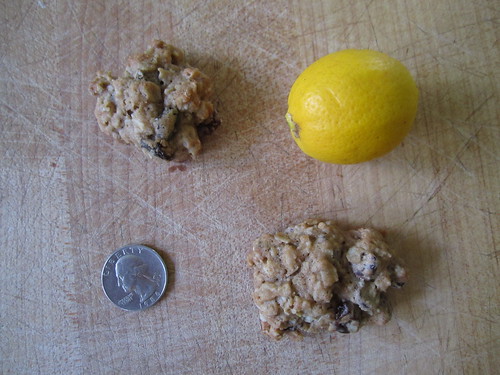
Smitten Kitchen is right, putting cookies in the freezer while the oven preheats does make otherwise-crunchy cookies into soft chewy cookies. Other than that, it's pretty much cookies. Simple, delicious cookies. And if you trust yourself to estimate 2/3 c in a 3/4 c measure, you can do it all with just a 3/4 c cup and a 1/2 t spoon. Using 1/2-1 T dough per cookie, I got about 40 smallish cookies (non-cookie objects shown for scale).
1 stick softened butter
2/3 c brown sugar
1 egg
1/2 t vanilla
3/4 c flour
1/2 t baking soda
1/2 t (heaping) cinnamon
1/2 t (shy) salt
1.5 oats
3/4 c raisins
3/4 c chocolate chips
Save the wrapper from the stick of butter, and use it to grease 2 or 3 baking sheets. Don't preheat the oven yet. Cream together the wet ingredients (butter through vanilla), stir in the dry ingredients (flour through salt), then stir in some fun bits (e.g., oats, raisins, and chocolate chips). Now it's time to preheat the oven to 350F. Drop cookie dough onto the prepared baking sheets, leaving a just a bit of room in between, sticking each pan in the freezer as it's filled up. When the oven is preheated and all the cookies have been in the freezer for at least a couple minutes, put the cookies in the oven. Bake for 10-12 minutes, rotating the pans halfway through, until the bottoms are starting to get golden but the tops aren't really coloring yet. Let the cookies sit on their pans for a few minutes so they can firm up a bit more, then transfer them to a cooling rack.
1 stick softened butter
2/3 c brown sugar
1 egg
1/2 t vanilla
3/4 c flour
1/2 t baking soda
1/2 t (heaping) cinnamon
1/2 t (shy) salt
1.5 oats
3/4 c raisins
3/4 c chocolate chips
Save the wrapper from the stick of butter, and use it to grease 2 or 3 baking sheets. Don't preheat the oven yet. Cream together the wet ingredients (butter through vanilla), stir in the dry ingredients (flour through salt), then stir in some fun bits (e.g., oats, raisins, and chocolate chips). Now it's time to preheat the oven to 350F. Drop cookie dough onto the prepared baking sheets, leaving a just a bit of room in between, sticking each pan in the freezer as it's filled up. When the oven is preheated and all the cookies have been in the freezer for at least a couple minutes, put the cookies in the oven. Bake for 10-12 minutes, rotating the pans halfway through, until the bottoms are starting to get golden but the tops aren't really coloring yet. Let the cookies sit on their pans for a few minutes so they can firm up a bit more, then transfer them to a cooling rack.
Saturday, January 28, 2012
Lemon poppyseed scones
Our Meyer lemon tree has produced loads of lemons again this year, but they seem like they might be slightly more mold-prone than last year's batch. It's easy enough to wash off, but this is probably a sign that I should be making more lemon things post-haste in case they go bad. Step one: scones to bring over to Laura's. Step two: lemonade with the leftover juice (just add water and sugar to taste). Step three: marmalade? Or another batch of limoncello?
3 c flour
1 T baking powder
1/4 c sugar
3 T (Meyer) lemon zest
3 T poppyseeds
1 stick (cold chopped salted) butter
1/2 c milk
1/4 c greek yogurt
1/4 c (Meyer) lemon juice
1 egg
glaze: 2 t (Meyer) lemon juice + couple T powdered sugar
Preheat oven to 400F. Mix the dry ingredients (flour through poppyseeds) together in a large bowl. Rub in the butter with your fingers until the pieces are small and flaky. Whisk together the wet ingredients (milk through egg) with a fork, then stir the wet ingredients into the dry with a wooden spoon. Turn out onto a floured board and knead by gently pressing the dough flat then folding it over a few times. Press into a rectangle ~3/4" tall and cut into wedges with a sharp knife. Bake for 15 min until golden and the butter has stopped bubbling. Transfer to a rack and let cool for a few minutes while you mix up the glaze to your desired consistency. Use the fork you used to mix up the glaze to drizzle it over the scones. Let cool another 20 minutes until the glaze has set, then pack up the scones and lemonade and hop on your bike.
3 c flour
1 T baking powder
1/4 c sugar
3 T (Meyer) lemon zest
3 T poppyseeds
1 stick (cold chopped salted) butter
1/2 c milk
1/4 c greek yogurt
1/4 c (Meyer) lemon juice
1 egg
glaze: 2 t (Meyer) lemon juice + couple T powdered sugar
Preheat oven to 400F. Mix the dry ingredients (flour through poppyseeds) together in a large bowl. Rub in the butter with your fingers until the pieces are small and flaky. Whisk together the wet ingredients (milk through egg) with a fork, then stir the wet ingredients into the dry with a wooden spoon. Turn out onto a floured board and knead by gently pressing the dough flat then folding it over a few times. Press into a rectangle ~3/4" tall and cut into wedges with a sharp knife. Bake for 15 min until golden and the butter has stopped bubbling. Transfer to a rack and let cool for a few minutes while you mix up the glaze to your desired consistency. Use the fork you used to mix up the glaze to drizzle it over the scones. Let cool another 20 minutes until the glaze has set, then pack up the scones and lemonade and hop on your bike.
Wednesday, January 11, 2012
Black-eyed peas and collards
I'm no expert on Southern-style beans and greens, but I like to try my hand at it once in a while. I got lucky this time—the broth is much more richly flavored than when I've used canned beans (without being oily or meaty), and the celery seeds make it smell amazing. Yeah the total time is almost two hours, but you still have loads of spare time to work on your poster for Mini Stat Mech, go to dance class, etc.
1 T butter
1 onion, diced
5 cloves garlic, minced
1 t each celery seeds, paprika, and oregano
3 medium-small carrots, sliced
1 can tomatoes
1.25 c dried black-eyed peas, rinsed
1.5 bouillon cubes in 4 c hot water
1 bunch collard greens, roughly chopped
red wine, salt, and pepper to taste
Melt the butter in a large pot, and saute the onion. Add the garlic, spices, and carrot, and saute until the spices seem like they're about to start sticking to the pan. Add the tomatoes, black-eyed peas, and broth, and bring to a boil. Cover and simmer for about 45 minutes. Add the collards and stir until they start to wilt. Cover and simmer for another 20 minutes. Adjust the seasonings if needed, and keep simmering until the black-eyed peas are tender (total simmering time should be about 90 minutes). Serve with rice and/or fresh sourdough bread.
1 T butter
1 onion, diced
5 cloves garlic, minced
1 t each celery seeds, paprika, and oregano
3 medium-small carrots, sliced
1 can tomatoes
1.25 c dried black-eyed peas, rinsed
1.5 bouillon cubes in 4 c hot water
1 bunch collard greens, roughly chopped
red wine, salt, and pepper to taste
Melt the butter in a large pot, and saute the onion. Add the garlic, spices, and carrot, and saute until the spices seem like they're about to start sticking to the pan. Add the tomatoes, black-eyed peas, and broth, and bring to a boil. Cover and simmer for about 45 minutes. Add the collards and stir until they start to wilt. Cover and simmer for another 20 minutes. Adjust the seasonings if needed, and keep simmering until the black-eyed peas are tender (total simmering time should be about 90 minutes). Serve with rice and/or fresh sourdough bread.
Persimmon bundt cake
When I bought persimmons at the farmers market this week, I took special care to choose ones that were squishy enough to be usable within a couple days, but not so squishy that they'd explode on the way home. Alas, one exploded anyway, so cake time it was! Jaime, Lester, and both Lauras were very happy with this cake.
cake:
1 c currants
1/2 c bourbon
2 c flour
2 t baking soda
2 t cinnamon
1/2 t cloves
1 t ginger
3/4 t salt
1 2/3 c sugar
3/4 c (1.5 sticks) unsalted butter, melted
1.5 c persimmon pulp, from 3 persimmons
3 eggs
2 t vanilla
1 c chopped pecans
glaze:
zest and juice from 1.5 Meyer lemons
enough powdered sugar to get your desired consistency, at least half a cup maybe?
Preheat oven to 350F and butter and flour a bundt pan. Combine the currants and bourbon in a small saucepan, bring to a simmer, then turn off the heat, cover, and let sit until the booze is mostly absorbed and things have cooled down. (Be careful if you're using a gas stove, I accidentally had a spurt of blue flames when adjusting the gas level.)
In a large bowl, stir together the dry ingredients (flour through sugar). (And yes the sugar goes with the dry ingredients here, which actually worked well because stirring the sugar in helped break up any flour chunks.) In a medium bowl, beat the melted butter with the persimmons until any persimmon chunks are blended and smooth, then beat in the eggs and vanilla. Gently fold the wet ingredients into the dry ingredients, then fold in the currants and whiskey, then fold in the pecans. Pour the batter into the pan and bake for 50 minutes, until a toothpick comes out clean.
Let the cake cool completely in the pan. Meanwhile, stir the glaze together with a fork until smooth, adding powdered sugar by the heaping spoonful until you get something glaze-like. I poured the glaze on the bottom of the cake, ie the side that's exposed while the cake is cooling in the pan, but you can also pour it on after the cake has been removed from the pan. Either way, poke the exposed cake surface all over with a toothpick to make holes for the glaze to seep in to, then drizzle the glaze evenly over the surface.
cake:
1 c currants
1/2 c bourbon
2 c flour
2 t baking soda
2 t cinnamon
1/2 t cloves
1 t ginger
3/4 t salt
1 2/3 c sugar
3/4 c (1.5 sticks) unsalted butter, melted
1.5 c persimmon pulp, from 3 persimmons
3 eggs
2 t vanilla
1 c chopped pecans
glaze:
zest and juice from 1.5 Meyer lemons
enough powdered sugar to get your desired consistency, at least half a cup maybe?
Preheat oven to 350F and butter and flour a bundt pan. Combine the currants and bourbon in a small saucepan, bring to a simmer, then turn off the heat, cover, and let sit until the booze is mostly absorbed and things have cooled down. (Be careful if you're using a gas stove, I accidentally had a spurt of blue flames when adjusting the gas level.)
In a large bowl, stir together the dry ingredients (flour through sugar). (And yes the sugar goes with the dry ingredients here, which actually worked well because stirring the sugar in helped break up any flour chunks.) In a medium bowl, beat the melted butter with the persimmons until any persimmon chunks are blended and smooth, then beat in the eggs and vanilla. Gently fold the wet ingredients into the dry ingredients, then fold in the currants and whiskey, then fold in the pecans. Pour the batter into the pan and bake for 50 minutes, until a toothpick comes out clean.
Let the cake cool completely in the pan. Meanwhile, stir the glaze together with a fork until smooth, adding powdered sugar by the heaping spoonful until you get something glaze-like. I poured the glaze on the bottom of the cake, ie the side that's exposed while the cake is cooling in the pan, but you can also pour it on after the cake has been removed from the pan. Either way, poke the exposed cake surface all over with a toothpick to make holes for the glaze to seep in to, then drizzle the glaze evenly over the surface.
Subscribe to:
Posts (Atom)