Last night I wanted my grains and protein and veggies, but didn't want the usual beans and pasta and kale, so I threw this together for some really delicious balanced-meal springtime food. Recommended cooking times for farro vary wildly so just go by whatever your package says. Mine took about half an hour, which is plenty of time to get the rest of the ingredients together.
1 c farro
1/2 stock cube in at least 4 c water
2 eggs
olive oil
5 stalks asparagus, sliced into small pieces on the bias
4 oz spinach, coarsely chopped
2 green onions, white and green parts thinly sliced
5 cherry tomatoes, quartered
juice of 1 lemon
2 oz crumbled feta
salt and pepper to taste
Bring the farro and stock to a boil then let simmer, covered, until the farro is tender and chewy. Meanwhile, prepare everything else: hard-boil and coarsely chop the eggs, saute the asparagus in some olive oil over medium heat until charred in a few spots, and prep the other veggies. When the farro is done, drain it if needed, then toss everything together in a large bowl until it's well mixed and the spinach is a bit wilted from the heat of the farro. Adjust the salt, pepper, lemon, and oil to taste, and enjoy.
Saturday, March 31, 2012
Sunday, March 11, 2012
Lemon curd cheesecake
This cheesecake doesn't look like anything special, but almost everyone who had some declared it to be one of the best cheesecakes ever. It's amazingly light and smooth, almost fluffy—probably because the yogurt (subbed for sour cream) is inside the filling, instead of being an extra layer on top. I plan on using this method for pretty much every cheesecake here on out, and I suggest that you try it too. The lemon curd is, unsurprisingly, also a delicious addition.
crust:
6 oz graham crackers
5 T melted butter
2 T sugar
Preheat the oven to 350F. Grind the ingredients together in a food processor, and press into the bottom and sides of a 9" springform pan. Bake for 10 minutes, then let cool while you make the filling.
filling:
20 oz (2.5 packs) cream cheese, softened
1 c sugar
3 eggs
3/4 c plain greek yogurt (nonfat ok)
1 t vanilla
1 c lemon curd
Preheat the oven to 300F. Beat together the cream cheese and sugar until fluffy, then beat in the eggs, yogurt, and vanilla until smooth. Pour half of the filling into the prepared crust, dollop on half of the lemon curd, top with the rest of the filling, then with the rest of the lemon curd. Swirl the filling and lemon curd together with a knife, gently and minimally. Place on a baking sheet (to catch possible drippage) and bake for about 1 hour (no more than 1hr 15min) until the edges are set but the center is still jiggly. Turn off the oven but keep the oven door closed, and let the cheesecake cool in the oven for at least an hour. At bedtime, cover the pan with plastic wrap, and chill in the fridge overnight.
Friday, March 2, 2012
Roasted cauliflower and mushrooms with dill, and kale risotto
That's a long title, and in fact this post contains two entirely separate recipes. But it's two recipes that can easily be made in parallel by one person, as the instructions indicate. And although I rarely make two complementary dishes when all the ingredients could go into one, I'm glad I did the two-dish thing this time—I think it turned out way better than if I'd tossed the cauliflower into the risotto.
roasted things:
oil
1/2 head cauliflower
8 oz crimini mushrooms
3/4 c loosely packed bread cubes/crumbs
salt and pepper
juice of half a lemon
1/3 c chopped fresh dill
light sprinkling of grated pecorino
risotto:
butter
1 large onion
several leaves of kale
1 c arborio rice
3/4 c white wine
2 c broth
2 oz grated pecorino
salt and pepper
Preheat the oven to 450F and melt some butter in a large frying pan over medium heat. Thinly slice the onion and get it started caramelizing in the frying pan. Break the cauliflower into bite-sized florets, and toss them with enough oil to coat in a 9x13" pan. Cover the pan with foil and put in the oven. While the cauliflower is softening, keep an eye on the onions, and halve the mushrooms and mince the kale. After the cauliflower has been steaming in the oven for about 15 minutes, stir in the mushrooms (adding more oil if needed) and return the pan to the oven (uncovered). When the onion is a bit caramelized (right about now), stir in the kale and rice, and saute for a couple minutes. Add the broth + wine to the rice in 1/2-1 c increments until the rice is tender, letting the liquid cook off in between additions, and stirring occasionally (20-30 minutes). Take that time to chop some stale baguette into bread crumbs, chop the dill, and grate the cheese. After the mushrooms have been roasting for 10-15 minutes, stir in the bread crumbs, and stir the roasting things every 5 minutes thereafter until they are nicely browned (about when the risotto is ready). To finish everything off, season with salt and pepper, stir a bunch of cheese into the risotto, and sprinkle the lemon, dill, and extra cheese over the roasted things. Serve a scoop of each next to each other on a plate.
Monday, February 27, 2012
What to do with 15 Meyer lemons
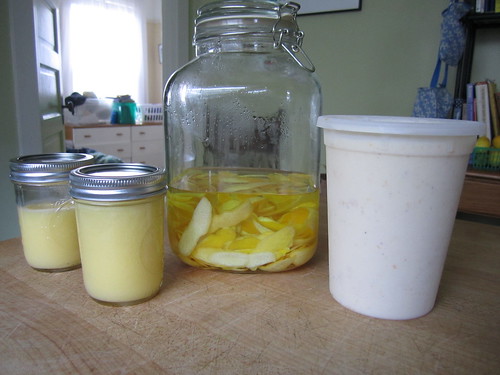
After several very busy weeks, I was able to collect a few hours yesterday morning for some project-scale cooking. Fifteen lemons were picked, peeled, and juiced:
And prepped like so:
(center) After scraping off any white pith on the peels, put them in this year's batch of limoncello.
Use 1 c lemon juice to make 3 c lemon curd (this time by adding the lemon juice to 1/3 c butter, 1.5 c sugar, and 5 eggs, and whisking over a double boiler until thick).
(right) Use half of the lemon curd in hot toddy ice cream (this time by whisking 1/4 c honey, 1/8 t cloves, 1 T lemon zest, 1.5 c cream, 1/2 c 1% milk, and 1/4 c bourbon into 1.5 c lemon curd, then chilling and churning as usual).
(left) Put the other half of the lemon curd in jars for later. It's almost but not quite overpoweringly sweet and tart, as lemon curd should be, and a good consistency for spreading or dolloping. (The sourdough pancakes were disappointingly rubbery though.)
Give the rest of the lemon juice to Laura so she can make some dressing for an asparagus + feta pasta salad.
Sunday, February 12, 2012
Beer + cheddar + mustard bread
Lester has been excited about this ever since Toni linked to it a few days ago. And what sounds like a better use of a Sunday than either writing a talk or making beer/cheddar/mustard bread? Adapting beer/cheddar/mustard bread for sourdough. The pull-apart style is great, but the rolls are very good too if that's more your speed.
bread:
1 t yeast
1/2 c pale beer (eg TJ's Mission St)
1 c starter
2.5 c bread flour
1/4 c rye flour
1/4 c wheat bran
1/2 stick butter, softened
1 egg
1.5 t salt
fillings:
3 T melted butter
1 T Dijon mustard
1.5 t bbq sauce
hot sauce to taste
1.5 c shredded cheddar
1 t mustard powder
1 t paprika
1/2 t salt
ground pepper
Dissolve the yeast in the beer, then combine all of the bread ingredients and knead until smooth and elastic. Let rise until doubled (about 6-8 hr). When you're about ready to form the bread, make the fillings: the mustard filling (stir together the melted butter, mustard, bbq sauce, and hot sauce until smooth) and the cheese filling (mix together the cheddar, mustard powder, paprika, salt, and pepper until the cheese is evenly coated with spices).
Butter a loaf pan (9x5") and find a muffin tin in case you have extra dough. Flour a surface and turn out the dough. Roll the dough into a rectangle that's at least 20"x12" (mine was closer to 24"x15") and has fairly straight sides and square corners. Spread the mustard filling evenly over the entire surface of the dough, then slice into 4"x12" (or longer, but not wider) strips. Sprinkle 1/(number of dough strips)ths of the cheese on one strip of dough, place another strip on top, sprinkle with more cheese, etc. Slice the stack into 2"-3" wide strips. Tip your loaf pan so it's standing on the short side, and stack the stacks on top of each other until the pan is full (4" side along the 5" side of the loaf pan, 2" side along the usually-vertical side of the pan). When you tip the pan back to its normal position, the slices of dough should be standing up like slices of bread, which is exactly what they are. If you have extra dough, butter that muffin tin and roll extra strips into little muffin-size rolls (I got 6 rolls). Cover with a plastic bag and let rise until the dough is puffy but not yet filling the pans (about 2-3 hr).
When Laura starts making dinner, preheat the oven to 350F. Bake for 30-35 minutes until nicely browned and very much filling the pans. Let cool for just a couple minutes, then remove from the pans. If the slices come out of the pan in chunks because some cheese got crusted onto the pan despite your thorough buttering, just stand those chunks next to each other on the cutting board and enjoy.
Friday, February 3, 2012
Basic sourdough bread
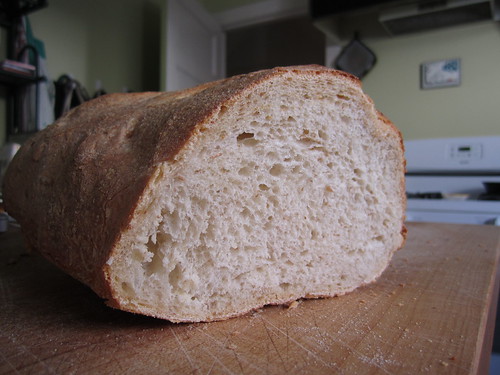
This is the "San Francisco" sourdough from Crust & Crumb. I've made it several times now, with various combinations of rising times, flours, and loaf shapes, and it's turned out extremely well every time. Golden crackly crust that's just the right thickness; soft crumb with lots of elasticity and structure; sourdough flavor that comes through nicely in a plain loaf but doesn't distract from a sweeter bread like cinnamon raisin; enough longevity to be edible three days later if it makes it that long.
The main difference from the La Brea sourdoughs is that the starter gets "elaborated" into what Reinhardt calls a firm starter and I call a proto-dough, which sits for a day or so before you actually make the bread. This step takes some planning ahead, but it's no more than 4 minutes of active time, and I think it helps make the timing of the later steps more flexible (although I haven't tried leaving it out so I can't say for sure).
You'll need to start with some sourdough starter, which I'd be more than happy to provide. The starter can sit in the fridge for several days between feedings (feed 1 c flour + 3/4 c room-temp water to 1 c starter). This makes 2.5 pounds of dough (enough for one huge, two medium, or one large and 1-3 small loaves).
proto-dough:
1 c starter that's been fed in the last day or two
1 c white bread flour
Knead the starter and flour together until it comes together into slightly sticky dough. It'll seem way too dry at first, but you shouldn't actually need to add any extra water. Place the dough in a medium bowl, cover with plastic wrap or a shower cap, and let sit at room temp until about doubled (I've left it for 6-12 hr, ie overnight or for a workday). Use now, or stick in the fridge for up to a day.
bread:
3 c white bread flour (13-14 oz); or 2 c white bread flour + 1 c other grains (whole wheat flour, polenta, etc) + 1 T gluten
1.5 t salt
1 t barley malt syrup (or sugar)
1 c room-temp water
up to 1/4 c wheat bran
up to 1 c extra goodies: oats, walnuts, sunflower seeds, raisins, etc
all of the proto-dough, torn into pieces (12-13 oz)
Combine all of the ingredients and knead until warm and elastic (6-8 min in a stand mixer with a dough hook on medium, or 10-15 min by hand). It's supposed to get up to 77-80F, but mine never has. Place the dough in a large bowl, cover with plastic wrap or a shower cap, and let sit at room temp until at least starting to rise (minimum 4 hr, but I've left it as long as 12 hr and it's more than doubled by then).
Prepare wherever you want the dough to rise: grease loaf pans for sandwich loaves, line baking sheets with parchment and sprinkle with semolina for free-form loaves, or flour a dishtowel and line a proofing basket or baking sheet for boules or baguettes (respectively). Transfer the dough onto a barely floured surface and divide into pieces for whatever loaves you want to make. For round boules, form the dough into a ball. For cylindrical loaves like batards, baguettes, or sandwich loaves, press the dough into a rectangle, roll or fold the sides over, pinch the seam together, and roll gently on the surface to smooth the seam. Place in your prepared proofing place (seam down for sandwich loaves or free-form loaves, seam up if you're putting it on a dishtowel. For baguettes, bunch up the towel in between the loaves, using the towel and the adjacent loaves to help guide the rising up rather than out (this is called a couche). Cover with a plastic bag and let rise until 1.5-2 times the size (ok for 3-8 hr). Bake when risen, or close the bag with a twisty tie and put in the fridge overnight.
If the loaves are in the fridge, take them out at least an hour before you want to put the bread in the oven. If they're on a towel, transfer onto semolina-ed parchment, seam side down. About half an hour before you want to put the bread in the oven, put a pizza stone in the oven if you have one and start preheating to 475F. Just before baking, cut the top of the loaves (these cuts will expand in the oven) and spray water all over the oven with a spray bottle. Slide the loaves with their parchment onto the pizza stone, making sure there's at least a few inches in between loaves, and spray the oven again. After a couple minutes, spray again and turn the heat down to 450F. Bake for 25-30 minutes total, rotating the loaves halfway through if needed. When the loaves are golden all over, turn off the heat and leave the bread in the oven for another 10 minutes to keep browning. Let cool on a rack for at least half an hour before slicing.
Soft oatmeal (& raisin & chocolate chip) cookies
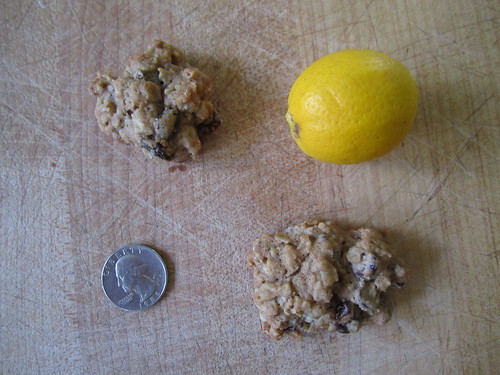
Smitten Kitchen is right, putting cookies in the freezer while the oven preheats does make otherwise-crunchy cookies into soft chewy cookies. Other than that, it's pretty much cookies. Simple, delicious cookies. And if you trust yourself to estimate 2/3 c in a 3/4 c measure, you can do it all with just a 3/4 c cup and a 1/2 t spoon. Using 1/2-1 T dough per cookie, I got about 40 smallish cookies (non-cookie objects shown for scale).
1 stick softened butter
2/3 c brown sugar
1 egg
1/2 t vanilla
3/4 c flour
1/2 t baking soda
1/2 t (heaping) cinnamon
1/2 t (shy) salt
1.5 oats
3/4 c raisins
3/4 c chocolate chips
Save the wrapper from the stick of butter, and use it to grease 2 or 3 baking sheets. Don't preheat the oven yet. Cream together the wet ingredients (butter through vanilla), stir in the dry ingredients (flour through salt), then stir in some fun bits (e.g., oats, raisins, and chocolate chips). Now it's time to preheat the oven to 350F. Drop cookie dough onto the prepared baking sheets, leaving a just a bit of room in between, sticking each pan in the freezer as it's filled up. When the oven is preheated and all the cookies have been in the freezer for at least a couple minutes, put the cookies in the oven. Bake for 10-12 minutes, rotating the pans halfway through, until the bottoms are starting to get golden but the tops aren't really coloring yet. Let the cookies sit on their pans for a few minutes so they can firm up a bit more, then transfer them to a cooling rack.
Subscribe to:
Posts (Atom)